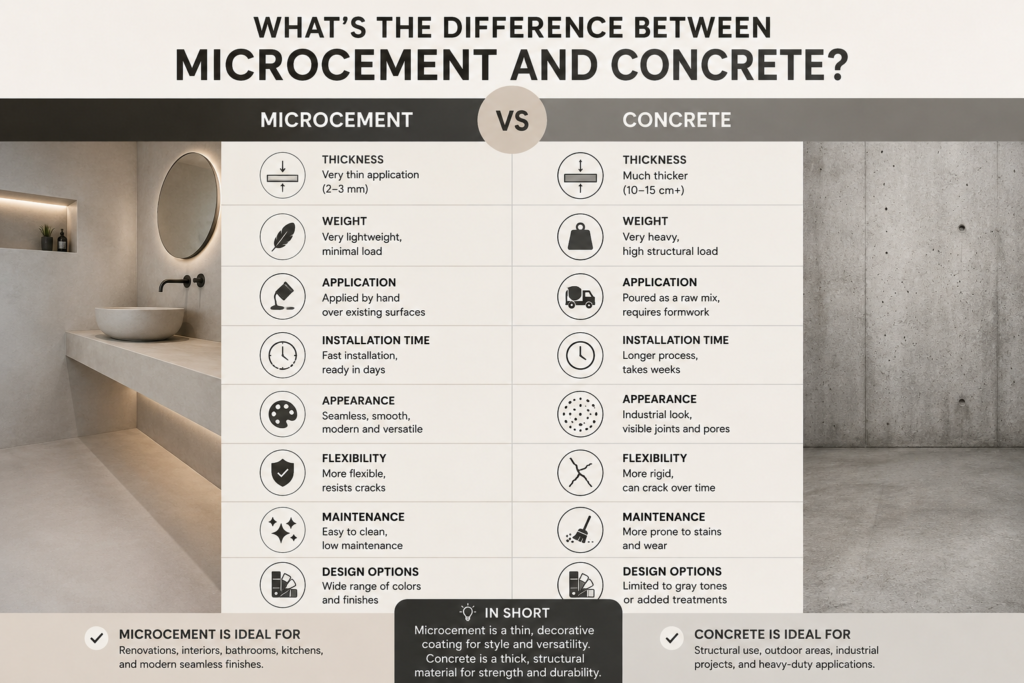
Although microcement and concrete can look very similar, they are completely different materials. Both create a contemporary, industrial-style finish, yet they differ in thickness, installation, weight, cost, and performance. Understanding these differences will help you choose the right solution for your home or commercial project.
What Is Microcement?
Microcement is a decorative cement-based coating that is applied in thin layers over existing surfaces. It combines cement, fine aggregates, resins, pigments, and additives to create a durable, seamless finish.
Unlike traditional concrete, microcement is typically only 2–3mm thick. As a result, installers can apply it directly over surfaces such as:
- Concrete
- Tiles
- Plasterboard
- Cement boards
- Screed
- MDF (when correctly prepared)
Because it bonds to existing substrates, microcement eliminates the need for expensive demolition in many renovation projects.
What Is Concrete?
Concrete is a structural building material made from cement, sand, aggregates, and water. Builders use it to construct foundations, floors, walls, driveways, and structural elements.
Concrete is much thicker than microcement, with floor slabs commonly measuring 100mm or more. Since it provides structural strength, it cannot simply be used as a decorative coating.
Thickness
One of the biggest differences between the two materials is thickness.
- Microcement: Approximately 2–3mm
- Concrete: Typically 75–150mm for floors
Therefore, microcement has virtually no impact on floor heights, door clearances, or fixtures. This makes it ideal for renovations.
Installation
Installing concrete usually involves excavation, formwork, reinforcement, pouring, curing, and finishing. Consequently, the process can take several weeks before the surface is ready for use.
Microcement installation is much less disruptive. Installers prepare the existing surface, apply several thin coats, sand between layers, and finish with a protective sealer. Most residential projects are completed within a few days.
Appearance
Both materials can achieve a polished concrete effect. However, there are subtle differences.
Concrete often displays natural aggregate, saw cuts, and expansion joints. It may also develop hairline cracks over time due to movement and curing.
Microcement creates a completely seamless finish with no grout lines or expansion joints across most interior surfaces. Furthermore, it is available in a wide range of colours and textures, allowing greater design flexibility.
Durability
Both materials are highly durable when installed correctly.
Concrete is exceptionally strong and supports heavy structural loads. However, it can crack naturally as buildings settle or temperatures fluctuate.
Microcement is not structural, but it provides excellent resistance to wear, moisture, and daily use when installed over a stable substrate and protected with high-quality sealers.
Waterproof Properties
Concrete is naturally porous and usually requires waterproofing in wet environments.
Microcement systems used in bathrooms, wet rooms, and showers incorporate waterproof membranes and protective sealers. Consequently, they create a waterproof decorative surface that is ideal for areas exposed to moisture.
Maintenance
Both finishes require relatively little maintenance.
Microcement is easy to clean because there are no grout lines to trap dirt or mould. Regular sweeping and mopping with a pH-neutral cleaner will keep the surface looking its best.
Concrete also requires routine cleaning, although polished concrete floors may need resealing periodically to maintain their appearance.
Cost
The overall cost depends on the size and complexity of the project.
Concrete often has a lower material cost for new structural builds. However, installation involves significant labour, equipment, and curing time.
Microcement generally costs more per square metre as a decorative finish, but it can reduce renovation costs because existing floors and walls often remain in place. As a result, homeowners save both time and demolition expenses.
Where Can They Be Used?
Microcement is suitable for:
- Bathrooms
- Wet rooms
- Kitchens
- Floors
- Walls
- Staircases
- Furniture
- Commercial interiors
Concrete is commonly used for:
- Foundations
- Structural floors
- Driveways
- Patios
- Industrial buildings
- Retaining walls
Which Should You Choose?
Choose microcement if you want a seamless, modern finish without removing existing surfaces. It is an excellent option for renovations, bathrooms, kitchens, and contemporary interiors.
Choose concrete if you need a structural building material capable of supporting significant loads or creating foundations and floor slabs.
Frequently Asked Questions
Does microcement contain concrete?
No. Although microcement is cement-based, it is a specialist decorative coating rather than structural concrete.
Can microcement be applied over concrete?
Yes. In fact, concrete provides one of the best substrates for microcement, provided it is stable, clean, and correctly prepared.
Does microcement look like polished concrete?
Yes. Many homeowners choose microcement because it closely replicates the appearance of polished concrete while offering a thinner, seamless finish.
Conclusion
Microcement and concrete may look alike, but they serve very different purposes. Concrete forms the structural backbone of a building, while microcement provides a stylish decorative finish that transforms existing surfaces with minimal disruption. If your goal is to achieve the look of polished concrete without increasing floor levels or carrying out major demolition, microcement is often the more practical solution.