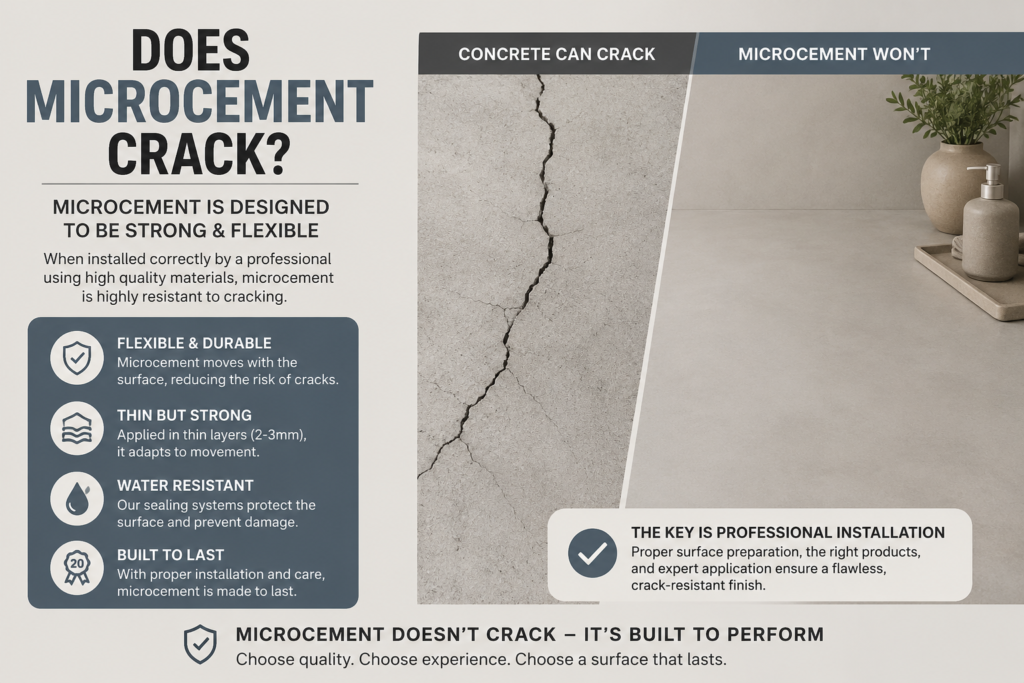
Microcement can crack, but the microcement itself is rarely the cause. In most cases, cracks occur because the substrate (the surface underneath) moves or already contains cracks that transfer through the coating.
When does microcement crack?
Microcement is applied in very thin layers, typically around 2–3 mm thick. Although it is strong and slightly flexible, it cannot bridge significant movement in the substrate.
Cracking is most likely if:
- The concrete or screed beneath it has existing cracks.
- Timber floors flex excessively.
- Expansion joints are covered instead of being respected.
- The substrate has not been properly prepared.
- Poor-quality materials or incorrect installation methods are used.
How can cracking be prevented?
A professional installation significantly reduces the risk of cracking. Key steps include:
- Repairing existing cracks before application.
- Using reinforcing mesh where required.
- Applying the correct primers for the substrate.
- Ensuring the substrate is clean, stable, and fully cured.
- Using a high-quality microcement system with compatible primers and sealers.
- Leaving movement joints in place where necessary.
Is microcement flexible?
Yes. Quality microcement has a degree of flexibility, making it more resistant to hairline movement than traditional cement finishes. However, it is not elastic enough to withstand major structural movement.
Does microcement crack over underfloor heating?
Not when installed correctly. In fact, microcement works very well with underfloor heating because its thin thickness allows heat to transfer efficiently. The heating system should be commissioned correctly, and the floor should be stable before installation.
Is cracking common?
No. When installed over a properly prepared substrate using premium materials, microcement should remain crack-free for many years. Most cracking problems can be traced back to inadequate substrate preparation or movement in the structure rather than the microcement itself.
Frequently Asked Questions
Can existing cracks in concrete show through microcement?
Yes. If existing cracks are not properly repaired before installation, they can reflect through the finished surface over time.
Can microcement crack in bathrooms or showers?
Moisture does not cause microcement to crack. As long as the substrate is stable and the system is correctly waterproofed and sealed, bathrooms and wet rooms perform very well.
Can you repair cracked microcement?
Minor hairline cracks can often be repaired, although the repair may remain slightly visible. If the crack is caused by movement in the substrate, that underlying issue should be addressed first to prevent it recurring.
Final thoughts
Microcement does not normally crack when it is installed over a stable, properly prepared substrate using quality materials. Choosing an experienced installer and following the manufacturer’s installation system are the best ways to achieve a durable, long-lasting, crack-free finish.