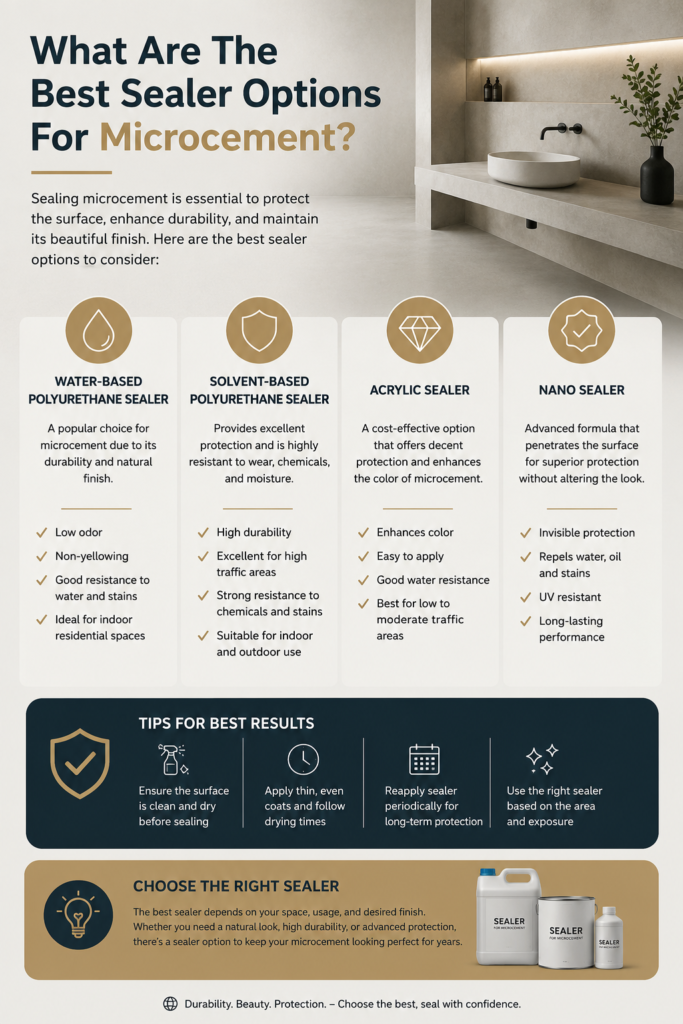
What Are The Best Sealer Options For Microcement? The best sealer for microcement depends on where you are installing it and how much wear the surface will receive. However, in most cases, a high-quality polyurethane (PU) sealer offers the best balance of durability, stain resistance, and appearance.
1. Polyurethane (PU) Sealer – Best Overall
Two-component polyurethane sealers are the most popular choice for professional microcement installations because they provide exceptional protection.
Benefits:
- Excellent resistance to scratches and abrasion
- Highly resistant to water and stains
- Protects against household chemicals and cleaning products
- Available in matt, satin, or gloss finishes
- Long-lasting with minimal maintenance
This is the recommended option for:
- Bathrooms
- Wet rooms
- Showers
- Kitchens
- Commercial spaces
- High-traffic floors
2. Water-Based Polyurethane Sealer
Water-based PU sealers have become increasingly popular because they combine excellent protection with low odour and environmentally friendly properties.
Advantages include:
- Low VOC emissions
- Quick drying times
- Clear finish that won’t yellow over time
- Easy application
- Excellent UV resistance
These sealers are ideal for residential interiors where maintaining the natural colour of the microcement is important.
3. Solvent-Based Polyurethane Sealer
Solvent-based polyurethane provides an exceptionally tough finish and is often chosen for demanding commercial environments.
Best for:
- Retail stores
- Restaurants
- Industrial settings
- Heavy foot traffic
Although extremely durable, they typically produce stronger odours during application and require good ventilation.
4. Acrylic Sealers
Acrylic sealers are generally used as an initial protective coat rather than the final wear layer.
Benefits:
- Helps regulate absorption
- Enhances colour slightly
- Easy to apply
- Cost-effective
However, acrylic sealers alone do not provide enough durability for most microcement surfaces and should normally be finished with a polyurethane topcoat.
Which Finish Should You Choose?
Your choice of finish affects both appearance and maintenance.
| Finish | Appearance | Best For |
|---|---|---|
| Matt | Natural, modern look | Contemporary homes and bathrooms |
| Satin | Soft sheen with easy cleaning | Kitchens, bathrooms and living areas |
| Gloss | High shine and reflective | Feature walls and decorative surfaces |
Satin is often the most practical choice because it combines a contemporary appearance with easier cleaning.
Why a Good Sealer Matters
Microcement is naturally porous before sealing. Applying the correct sealer helps to:
- Prevent water penetration
- Protect against food and drink stains
- Increase scratch resistance
- Make cleaning much easier
- Extend the life of the installation
- Preserve the colour and finish
Without proper sealing, even high-quality microcement can absorb moisture and become more susceptible to staining.
How Often Should Microcement Be Resealed?
The lifespan of a sealer depends on usage.
- Residential walls: Every 7–10 years
- Residential floors: Every 5–7 years
- Bathrooms and showers: Around every 4–6 years
- Commercial floors: Every 2–4 years, depending on foot traffic
Regular cleaning with pH-neutral products will help maximise the life of the sealer.
Final Thoughts
For most installations, a two-component water-based polyurethane sealer is the best option. It provides outstanding durability, excellent stain and water resistance, and a choice of matt, satin, or gloss finishes. When combined with a suitable primer or acrylic base coat, it ensures your microcement remains attractive and protected for many years.
Click HERE to buy quality Microcement
What Are The Best Sealer Options For Microcement?